
How Climate Affects Deck Lifespan – And What This Means For BC’s Lower Mainland Homeowners
When homeowners in BC’s Lower Mainland plan a new deck or replacement, one big question always comes up: “How long will my deck really last?” The answer depends not just on materials and craftsmanship, but also on one of our region’s most influential factors — the climate.
British Columbia’s Lower Mainland (made up of the Fraser Valley, Langley, Chilliwack, Abbotsford and Mission) experience heavy rainfall, high humidity, and year-round moisture. Understanding how these conditions impact your deck — and how to build for long-term performance — can mean the difference between a deck that needs frequent repairs and one that lasts for decades.
Why Climate Matters
High annual precipitation means decks are regularly exposed to prolonged moisture and humidity, as well as intermittent freeze-thaw cycles. These conditions make moisture management critical — not just for the surface boards but for the entire deck structure. Moisture trapped in wood leads to rot, mold, and decay.
Moisture Is the Enemy of Lifespan
Whether it’s rain, fog, or high humidity, persistent wet conditions accelerate wear and tear on decking materials.
Wood Decks
Traditional wood decks — such as pressure-treated lumber or cedar — are organic and absorbent. In moist climates, water absorption can lead to rot and structural weakening in addition to warping, splintering and cracking.
This is why untreated wood decks often need full replacement in as little as 10–15 years in damp climates.
 Composite & PVC Decks
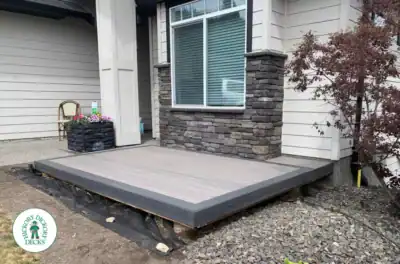
Modern engineered materials are far superior at moisture resistance. Composite decking (plastic blended with natural fibres such as wood or bamboo) resists rot and weathering far better than wood, often lasting 25-30+ years. PVC decking can last even longer (30+ years) as it contains no wood fibres whatsoever and is essentially waterproof.
In regions subject to frequent rainfall, these moisture-resistant materials typically outperform traditional wood by wide margins.
The Impact of Seasonal Changes
Rainfall isn’t the only thing that affects decking – seasonal swings play a role too. Although winters are milder in BC than in many parts of Canada, occasional freezing can still occur. Water that seeps into small cracks can expand when it freezes, which causes stress on boards, fasteners and connections. Temperature shifts cause decking materials to expand and contract. In the case of wood, this can lead to splitting and loosening of fasteners over time.
BC’s Lower Mainland climate places extra demands on decks, but with the right materials and thoughtful construction, you can build an outdoor space that looks and performs great for decades.
If you’re planning a new deck, reach out to a Hickory Dickory Decks representative to discuss the best decking choices for your area.